 |
This is Gateshead Metro Station which is part of the Tyne & Wear Metro system which now has 60 stations on it and is used by about 40 million people a year and covers about 48 miles of track. The Metro alignment includes most of two of the world's oldest passenger railways: the Newcastle & North Shields Railway (Metro between Chillingham Road and North Shields) and the Brandling Junction Railway (between Gateshead and Monkwearmouth). Both opened in 1839, making the Metro arguably one of the world's oldest local rail transport systems. The Tyne and Wear Metro was also the first railway in the UK to operate using the metric system; all its speeds and distances are measured in metric units only. |
Monday, 18 April 2011

Tuesday, 15 June 2010
June 15, 2010 Great North Run Finish

Ever wondered what the Finish line of the great North Run looks like at South Shields - well this is the view that awaits me in 12 weeks and it's a familiar one as I will be completing my 30th GNR in September.
My first run was in 1981 when i managed a time of 1hour 59 minutes ..... as you can see 30 years on and I'm still getting faster !!!
Please check out my sponsor site which isin aid of the Percy Hedley School in North Tyneside.
Percy Hedley School specialises in working with three distinct groups of children. Our work with children who have cerebral palsy is based on Conductive Education as practised at the Peto Institute in Budapest. Specialist teachers and therapists provide an integrated approach to working with children who have speech, language and communication difficulties and complex difficulties including dyspraxia, dyslexia and ADHD (attention deficit hyperactivity disorder). The school has considerable experience of working with children on the autistic spectrum who show the potential to access a group approach with support. Following our merger with Northern Counties School we have launched a new, highly specialised education provision for children with hearing impairment based at our secondary school provision.
Northern Counties School has a national reputation for excellent practice and provides education, therapy and care for children with hearing and visual impairment, complex needs and autism. The school specialises in a total communication approach.
Northern Counties School has a national reputation for excellent practice and provides education, therapy and care for children with hearing and visual impairment, complex needs and autism. The school specialises in a total communication approach.
Thursday, 10 June 2010
June 10, 2010 Lord Collingwood Memorial

Lord Collingwood was second in command to Nelson ant Trafalgar and took over command upon his death.
Collingwood was born in Newcastle upon Tyne. His early education was at the Royal Grammar School, Newcastle. The canons which you can see at the base of the monument are from the Royal Sovereign which was Collingwoods ship at the Battle of Trafalgar second in command to nelson on the Victory.
Wednesday, 9 June 2010
June 09, 2010 St Hilda's Sundial

I came across this Sundial whilst in St Hilda's church grounds - not much of a story ... ut it is very old - 1724 it says on this side and on the front it says 1704.
Monday, 7 June 2010
June 07, 2010 Tynemouth Life Brigade
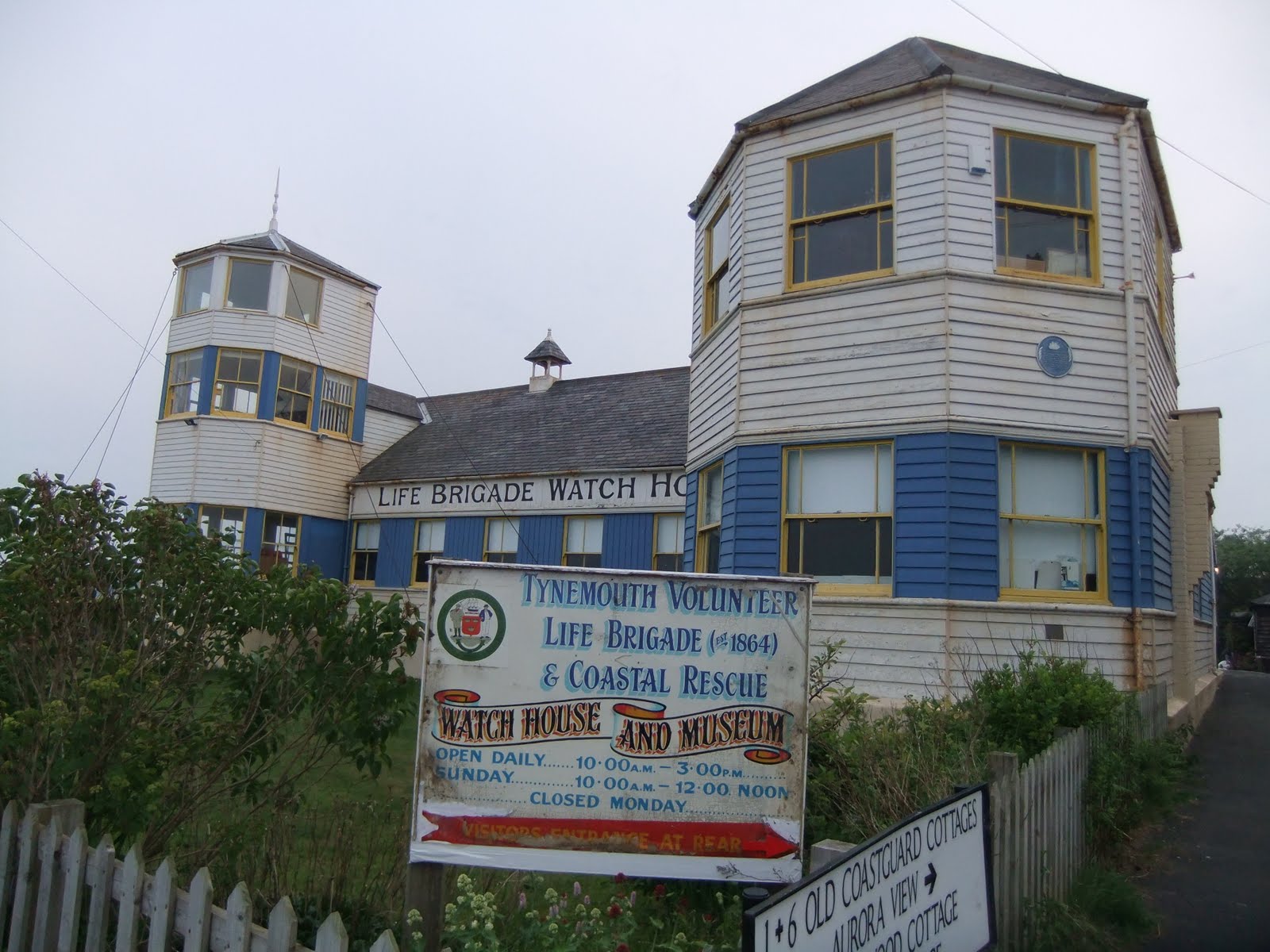
Tynemouth Life brigade watch house looks out across the pier entrance from its position on top of the hill inside the Tynemouth pier. It has great views of not only the piers but the also the Black Middens and across to South Shields and right down the coast as far as Souter Point lighthouse.
The Tynemouth Volunteer Life Brigade is a voluntary shore based coastal rescue service founded in 1864. It is a Declared Facility to HM Coastguard for Rope Rescue, Coastal Search and Rescue and one of the last remaining trained teams for Ship to Shore Breeches Buoy Rescue.
The Brigade Watch House Museum is packed full of fascinating and unique artefacts of the Brigade's history, ranging from the Ship's bell from one of the Shipwrecks that led to the creation of the Brigade in 1864 to a picture of Her Majesty The Queen visiting the Brigade in October 2005. Furthermore behind every picture and relic is a captivating story about how it links into both the Brigade's past and present role as a Voluntary Life Brigade on the North Tyneside Coastline.
The Watch House is manned by Billy, the caretaker, and his wife Kath, who help keep the Museum in pristine condition and are on hand to ensure your visit to the Museum is interesting and informative. Guided tours and talks about the Brigade can be arranged and held at the Museum by either e-mailing the web site or by speaking to Billy.
Sunday, 6 June 2010
June 06, 2010 South Shields Old Town Hall

Here is a full view of the old Town hall at South Shields taken from near the market stalls - the church you can see in the background is St Hildas which will feature in future posts - the local colliery in South Shields was actually also named St Hildas Colliery and closed in 1940.
The enterprising Simon Temple, Esq., first won a colliery here on the ground of the dean and chapter of Durham, which was hence called Chapter Main Colliery. The first coals were conveyed to the spout, amidst great rejoicings, on April 23, 1810. The great expense of the undertaking, however, compelled that gentleman to stop payment; when the concern fell into the hands of Messrs. Brown, of London, proprietors of Jarrow Colliery, and who sold the lease to Messrs. Devey. The present colliery belongs to Robert, William, and John Brandling, Esqrs. The pit was bottomed at the Bensham Seam in July, 1825; the shaft being about 143 fathoms deep. The average thickness of the seam is about 6 feet; and the workings extend to the south of the shaft, which is situated at a short distance from St. Hilda's church, South Shields. The strata rise towards the sea. The pumping engine is of 90 horse power; and there are two drawing engines, each of 30 horse power. There is also a steam-engine of 20 horse power in the mine. The shaft is divided into an upcast and downcast, by means of a brattice.
June 05, 2010 South Shields Market Place

This is the view from the centre of South Shields market place - obviously not on a market day. The building I am standing underneath sits at the centre of the square and in fact used to be South Shields Town Hall until 1910 when the magnificent new Town Hall was built. The old Town Hall was built in 1768 and the centre column pictured here is reputed to be the remains of an earlier market cross.
Friday, 4 June 2010
June 04, 2010 Trinity House

This plaque can be found on Trinity House in Newcastle just behind the Quayside opposite the Sage.
Trinity House, Newcastle, is a Maritime organisation, dedicated to safe navigation and welfare of seamen.
Established in 1492, the organisation was granted a Royal Charter of Incorporation in 1536 by King Henry VIII and has operated by Royal Chater ever since.
Its principal work today is to Examine, Licence and Administer Deep-Sea Pilots. The House administers an education and training programme for Sea-Scouts, Sea-Cadets and other youth organisations.
The House also maintains the buildings and preserves the heritage and ancient traditions of this unique organisation
The Buildings forming the Trinity House complex include -
The private Brethrens Chapel- 1505
The entrance Hall - 1800
The Banqueting Hall and Board Room- 1721
Thursday, 3 June 2010
June 03, 2010 Newcastle Opera House

The Stoll on Westgate road is Newcastle Opera House.
Tyne and Wear has a fair share of theatres and most of them are based at the Eastern region. The major theatres among them are the Empire in Sunderland and the Theatre Royal in Newcastle. Apart from this, Newcastle has another theatre called the Newcastle Opera house. The Opera House is a traditional theatre and is rated by many, as one of the finest examples of Victorian theatre. Apart from the main auditorium, which has a capacity of over 1100, some performances also take place at the Bistro Bar. This is ideal for less-formal settings.
One of the most important theatres in Britain - the Newcastle Opera House was opened in 1867. The theatre was originally named 'The Tyne Theatre and Opera House' and later in the year 2000, the name was simplified to 'Newcastle Opera House'. As the name suggests, the theatre in Newcastle is the best place in the city for music concerts. Apart from music concerts, other performing arts such as plays, musicals and cinemas also take place at the Newcastle theatre.
The most important feature of the theatre in Newcastle is the acoustics, which deserve special mention. This auditorium has probably the finest acoustic abilities in the whole of Britain. To ensure this, the walls are lined with wood and the ceiling is very special indeed. The dome of the theatre is also made from wood and carries the smallest whisper on stage to the far corners of the gallery. In the early 19th century, the Newcastle theatre was converted to a cinema and renamed as the Stoll Picture house. The opera house served as a cinema until 1974, when it was closed for showing x-rated films. However the theatre sustained a heavy fire during 1985, which left the back stage and the proscenium severely damaged. With efforts from Jack Dixon, the theatre was renovated and started conducting plays along the Tyneside.
The most important feature of the theatre in Newcastle is the acoustics, which deserve special mention. This auditorium has probably the finest acoustic abilities in the whole of Britain. To ensure this, the walls are lined with wood and the ceiling is very special indeed. The dome of the theatre is also made from wood and carries the smallest whisper on stage to the far corners of the gallery. In the early 19th century, the Newcastle theatre was converted to a cinema and renamed as the Stoll Picture house. The opera house served as a cinema until 1974, when it was closed for showing x-rated films. However the theatre sustained a heavy fire during 1985, which left the back stage and the proscenium severely damaged. With efforts from Jack Dixon, the theatre was renovated and started conducting plays along the Tyneside.
Wednesday, 2 June 2010
June 02, 2010 Northumberland Street
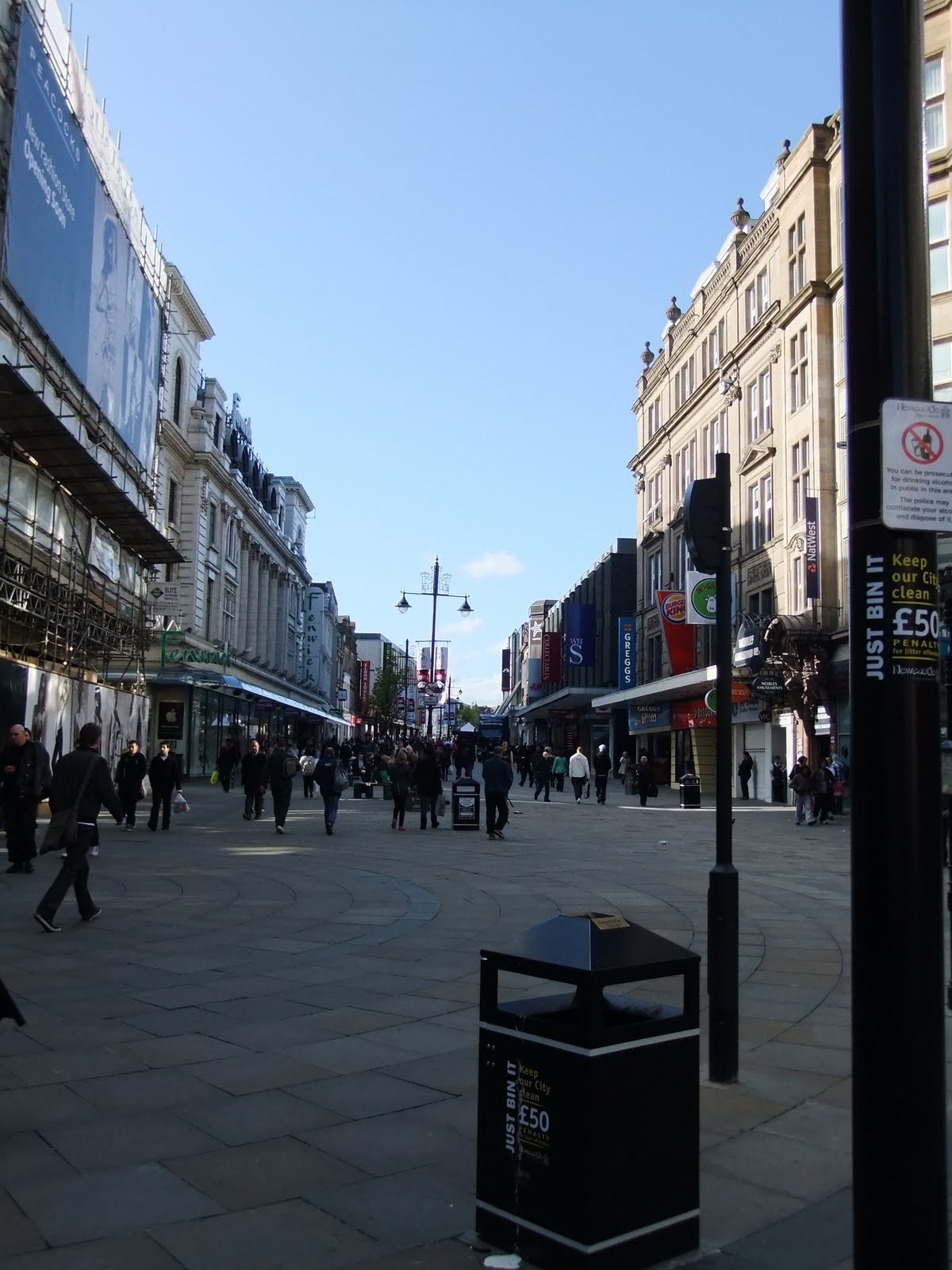
Northumberland Street is a major shopping street in the city of Newcastle upon Tyne, North East England. In terms of the cost of rent per square metre, it is the most expensive location in the UK outside of London to own a shop.
The street runs from the Haymarket and Civic Centre in the north, towards theMonument at the south. It encompasses the entrance to the Eldon Square andMonument Mall shopping centres. It is home to a number of retailers, cafes and banks including:Northumberland Street Newcastle is a busy shopping street where you will find all the familiar names like Marks & Spencer, WH Smith, Dixons, Argos, HMV, JJB Sports, Primark etc. but you will also find some local favourites too like Greggs and the large white store on the left is Fenwicks department store which I always thought was only found in Newcastle but there are actually 8 stores around the UK.Northumberland Street is Newcastle's main shopping street. Its popularity has led to it being dubbed the "Oxford Street of the North" and it's easy to see why. It's the home of many famous names and department stores. These include the flagship of the provincial Marks and Spencer stores, Fenwick, BHS, Next, HMV, and many, many more. Some of these also have direct access to Eldon Square.
Tuesday, 1 June 2010
June 01, 2010 Cycling View Tyneside Bridges

This is the view I get cycling into town across the Redheugh Bridge on the way into Newcastle - the eagle eyed will be able to spot in order - The King Edward Bridge, The Queen Elizabeth II Bridge, The High Level Bridge, The Swing Bridge, The Tyne Bridge and the Millenium Bridge.
May 31, 2010 River God Tyne

This statue of River God Tyne can be found on Newcastle Civic Centre. It was commissioned for the new Civic Centre the 'River God Tyne' is one of the eight rivers represented on the sculptures on the front of Somerset House, London dating from 1786. The original mask was surmounted by a basket of coals surrounded by a variety of motifs and emblems symbolising different trades peculiar to the Tyne Valley. It portrays the river God in human form, a fountain within his outstretched hand coursing a constant stream of water along the tortured and twisted torso of the aquatic diety.
Sunday, 30 May 2010
May 30, 2010 George & Dragon War Memorial

St George & the Dragon can be found in Old Eldon Square in Newcastle and the new development of Eldon Square behind the statue actually used to be a pub called The George & Dragon.
The monument is a Grade II listed building and is made of Granite, Portland Stone and Bronze. It was created by Charles Hartwell and unveiled by Earl Haig in 1923.
It is actually one of a pair and the sister statue can be found close to Lords Cricket Ground in London , both statues were payed for by public subscription and are to commemorate men lost in the Great War.
St George is the patron saint of the Northumberland Fusiliers. It is Newcastle’s official war memorial.
Saturday, 29 May 2010
May 29, 2010 Blackfriars

Blackfriars in Newcastle lies behind The Gate liesure complex and China Town in Stowell Street.
During the early years of the 13th century, orders of friars began to establish themselves in England. Newcastle came to have five friaries within its walls: Blackfriars (Dominican) established in 1239; Whitefriars (Carmelite) established in 1262; Austinfriars (Augustinian) established in 1290 (now the site of the Holy Jesus Hospital); Greyfriars (Franciscans) established in 1274 and the Trinitariansestablished in 1360. There was also the nunnery of St Bartholomew’s founded in 1086 near the present Nun Street.
During the Reformation begun by Henry VIII in 1536, the five Newcastle friaries and the single nunnery were dissolved and the land was sold to the Corporation and to rich merchants. At this time there were fewer than 60 inmates of the religious houses in Newcastle. The convent of Blackfriars was sold to the mayor and burgesses of Newcastle, who then leased it to nine of the town’s craft guilds, to be used as their headquarters. This probably explains why it is the only one of the religious houses whose building survives to the present day.
Friday, 28 May 2010
May 28, 2010 Grey's Monument

The magnificent Grey's Monument in Newcastle was erected in 1838 which makes it 172 years old and commemorates Earl Charles Grey II who was Prime Minister of the UK & Ireland from 1830 - 1834 and was the main architect in seeing the Reform Act through the House of Commons in 1832.
The Reform Act of 1832 saw the reform of the House of Commons and the abolition of slavery throughout the British Empire in 1833.
The column is 135 feet high which is about 16 feet lower than Nelson's Column in London, however it is about 12 years older.
Earl Grey Tea blend is named after Earl Grey, who reputedly received a gift, probably a diplomatic perquisite, of tea flavoured with bergamot oil, taken from bergamot, a citrus fruit typical ofSoutheast Asia and grown commercially in Italy.
Wednesday, 26 May 2010
May 26,2010 Northumbria University Bridge

Northumbria University expanded across the central Motorway in Newcastle and the old standard footbridges was replaced with a state of the art new Bridge - this is the Central support you can see for the new cable stayed bridge which opened in 2007.
In 2007 City Campus was expanded with the building of the £100m extension at City Campus East. This purpose-built accommodation houses the Schools of Design, Law and Business. A stunning footbridge links City Campus East to the established site at City Campus West which is undergoing major renovation including the building of a new multi-million pound sports centre. Scheduled to open in 2010, this facility will contain a four-court hall, spectator seating for 2,500 people, 150-station fitness suite, exercise/dance studios, teaching rooms, squash courts, fencing room, a 40m sprint training track and a 6 lane 25-metre swimming pool.
Tuesday, 25 May 2010
May 25, 2010 The Laing Art Gallery

The Laing Art gallery is located on the East side of the City centre just near the new City Library.
Situated in the centre of Newcastle, the Laing is home to an impressive collection of art and sculpture. Its exhibition programme is renowned for bringing the biggest names in art to the North East and includes historic, modern and contemporary art.
This gallery has a Designated Collection of national importance and its permanent displays feature important 18th and 19th century paintings including dramatic landscapes by John Martin.
Monday, 24 May 2010
May 24,2010 The Gate

Reflections in The Gate Newcastle which include the new Eldon Square extension which opened in February this year. Inside The Gate you will find the Empire 12 screen Cinema as well as Aspers Casino and many Bars and restaurants including Nando's, TGI Friday's, Tiger Tiger, Opera, Beyond and Lloyds No1 Bar.
The Gate complex was built in on the site of the old Mayfair club which was famous throughout the North of England as a unique Rock Venue.
Sunday, 23 May 2010

Friday, 21 May 2010
May 21, 2010 Town Moor

A different view of St James park taken whilst on the way home from a 50 cycle ride around Northumberland. This is the view from across the Town Moor which lies to the North of Newcastle.
The Town Moor is a large area of common land in Newcastle upon Tyne. It covers an area of around 400ha[1], and is larger than Hyde Park and Hampstead Heath combined, stretching from the city centre and Spital Tongues in the south out to Cowgate/Kenton Bar to the west,Gosforth to the north and Jesmond to the east.
The freemen of the City have the right ot graze their cattle on the moor and although not in this shot, there were plenty cattle on the moor.
Subscribe to:
Posts (Atom)
