Showing posts with label Newcastle. Show all posts
Friday, 4 June 2010
June 04, 2010 Trinity House
This plaque can be found on Trinity House in Newcastle just behind the Quayside opposite the Sage.
Trinity House, Newcastle, is a Maritime organisation, dedicated to safe navigation and welfare of seamen.
Established in 1492, the organisation was granted a Royal Charter of Incorporation in 1536 by King Henry VIII and has operated by Royal Chater ever since.
Its principal work today is to Examine, Licence and Administer Deep-Sea Pilots. The House administers an education and training programme for Sea-Scouts, Sea-Cadets and other youth organisations.
The House also maintains the buildings and preserves the heritage and ancient traditions of this unique organisation
The Buildings forming the Trinity House complex include -
The private Brethrens Chapel- 1505
The entrance Hall - 1800
The Banqueting Hall and Board Room- 1721
Thursday, 3 June 2010
June 03, 2010 Newcastle Opera House
The Stoll on Westgate road is Newcastle Opera House.
Tyne and Wear has a fair share of theatres and most of them are based at the Eastern region. The major theatres among them are the Empire in Sunderland and the Theatre Royal in Newcastle. Apart from this, Newcastle has another theatre called the Newcastle Opera house. The Opera House is a traditional theatre and is rated by many, as one of the finest examples of Victorian theatre. Apart from the main auditorium, which has a capacity of over 1100, some performances also take place at the Bistro Bar. This is ideal for less-formal settings.
One of the most important theatres in Britain - the Newcastle Opera House was opened in 1867. The theatre was originally named 'The Tyne Theatre and Opera House' and later in the year 2000, the name was simplified to 'Newcastle Opera House'. As the name suggests, the theatre in Newcastle is the best place in the city for music concerts. Apart from music concerts, other performing arts such as plays, musicals and cinemas also take place at the Newcastle theatre.
The most important feature of the theatre in Newcastle is the acoustics, which deserve special mention. This auditorium has probably the finest acoustic abilities in the whole of Britain. To ensure this, the walls are lined with wood and the ceiling is very special indeed. The dome of the theatre is also made from wood and carries the smallest whisper on stage to the far corners of the gallery. In the early 19th century, the Newcastle theatre was converted to a cinema and renamed as the Stoll Picture house. The opera house served as a cinema until 1974, when it was closed for showing x-rated films. However the theatre sustained a heavy fire during 1985, which left the back stage and the proscenium severely damaged. With efforts from Jack Dixon, the theatre was renovated and started conducting plays along the Tyneside.
Wednesday, 2 June 2010
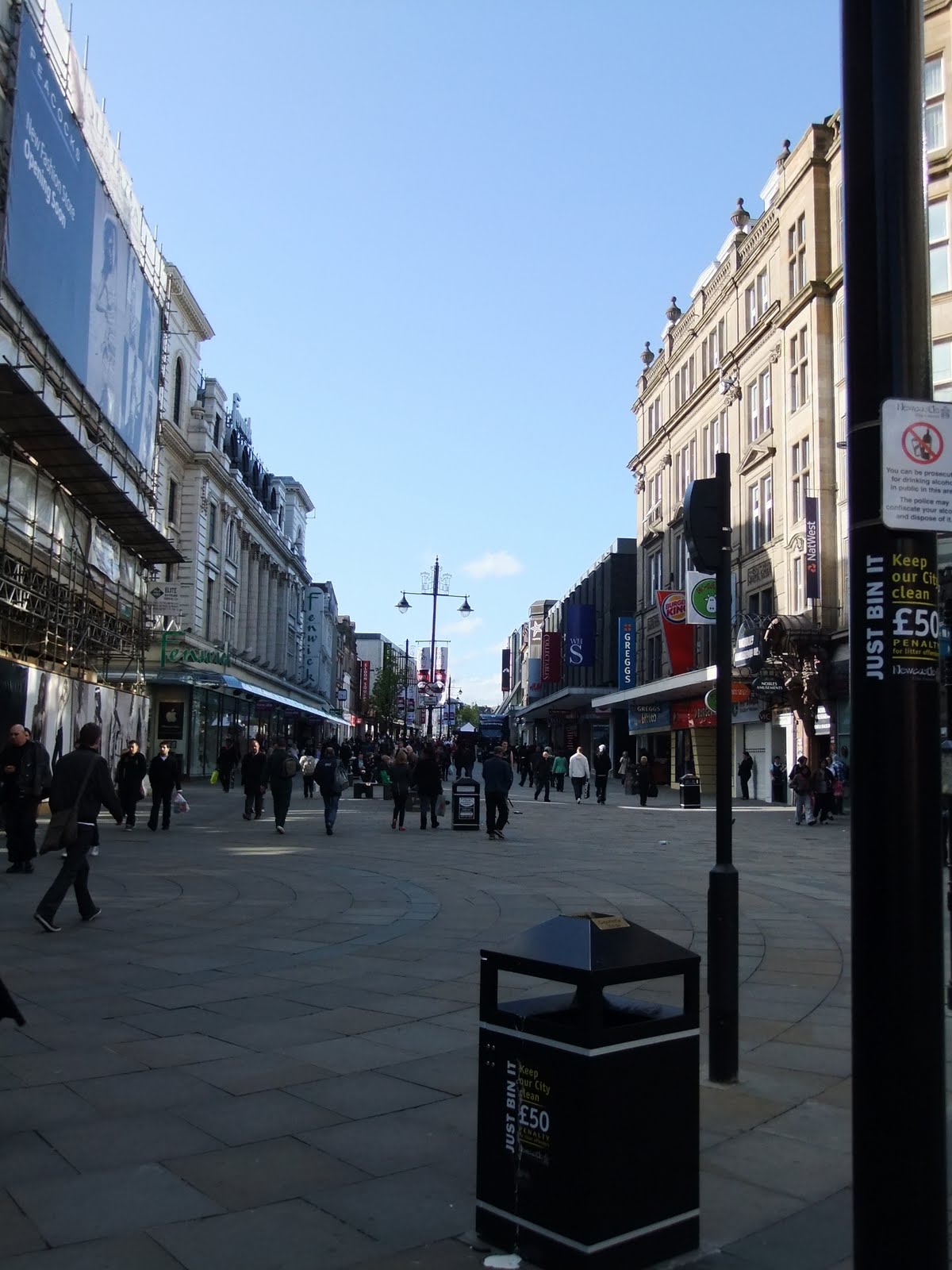
June 02, 2010 Northumberland Street
Northumberland Street is a major shopping street in the city of Newcastle upon Tyne, North East England. In terms of the cost of rent per square metre, it is the most expensive location in the UK outside of London to own a shop.
The street runs from the Haymarket and Civic Centre in the north, towards theMonument at the south. It encompasses the entrance to the Eldon Square andMonument Mall shopping centres. It is home to a number of retailers, cafes and banks including:Northumberland Street Newcastle is a busy shopping street where you will find all the familiar names like Marks & Spencer, WH Smith, Dixons, Argos, HMV, JJB Sports, Primark etc. but you will also find some local favourites too like Greggs and the large white store on the left is Fenwicks department store which I always thought was only found in Newcastle but there are actually 8 stores around the UK.Northumberland Street is Newcastle's main shopping street. Its popularity has led to it being dubbed the "Oxford Street of the North" and it's easy to see why. It's the home of many famous names and department stores. These include the flagship of the provincial Marks and Spencer stores, Fenwick, BHS, Next, HMV, and many, many more. Some of these also have direct access to Eldon Square.
Tuesday, 1 June 2010
June 01, 2010 Cycling View Tyneside Bridges
This is the view I get cycling into town across the Redheugh Bridge on the way into Newcastle - the eagle eyed will be able to spot in order - The King Edward Bridge, The Queen Elizabeth II Bridge, The High Level Bridge, The Swing Bridge, The Tyne Bridge and the Millenium Bridge.
May 31, 2010 River God Tyne
This statue of River God Tyne can be found on Newcastle Civic Centre. It was commissioned for the new Civic Centre the 'River God Tyne' is one of the eight rivers represented on the sculptures on the front of Somerset House, London dating from 1786. The original mask was surmounted by a basket of coals surrounded by a variety of motifs and emblems symbolising different trades peculiar to the Tyne Valley. It portrays the river God in human form, a fountain within his outstretched hand coursing a constant stream of water along the tortured and twisted torso of the aquatic diety.
Sunday, 30 May 2010
May 30, 2010 George & Dragon War Memorial
St George & the Dragon can be found in Old Eldon Square in Newcastle and the new development of Eldon Square behind the statue actually used to be a pub called The George & Dragon.
The monument is a Grade II listed building and is made of Granite, Portland Stone and Bronze. It was created by Charles Hartwell and unveiled by Earl Haig in 1923.
It is actually one of a pair and the sister statue can be found close to Lords Cricket Ground in London , both statues were payed for by public subscription and are to commemorate men lost in the Great War.
St George is the patron saint of the Northumberland Fusiliers. It is Newcastle’s official war memorial.
Friday, 28 May 2010
May 28, 2010 Grey's Monument
The magnificent Grey's Monument in Newcastle was erected in 1838 which makes it 172 years old and commemorates Earl Charles Grey II who was Prime Minister of the UK & Ireland from 1830 - 1834 and was the main architect in seeing the Reform Act through the House of Commons in 1832.
The Reform Act of 1832 saw the reform of the House of Commons and the abolition of slavery throughout the British Empire in 1833.
The column is 135 feet high which is about 16 feet lower than Nelson's Column in London, however it is about 12 years older.
Earl Grey Tea blend is named after Earl Grey, who reputedly received a gift, probably a diplomatic perquisite, of tea flavoured with bergamot oil, taken from bergamot, a citrus fruit typical ofSoutheast Asia and grown commercially in Italy.
Wednesday, 26 May 2010
May 26,2010 Northumbria University Bridge
Northumbria University expanded across the central Motorway in Newcastle and the old standard footbridges was replaced with a state of the art new Bridge - this is the Central support you can see for the new cable stayed bridge which opened in 2007.
In 2007 City Campus was expanded with the building of the £100m extension at City Campus East. This purpose-built accommodation houses the Schools of Design, Law and Business. A stunning footbridge links City Campus East to the established site at City Campus West which is undergoing major renovation including the building of a new multi-million pound sports centre. Scheduled to open in 2010, this facility will contain a four-court hall, spectator seating for 2,500 people, 150-station fitness suite, exercise/dance studios, teaching rooms, squash courts, fencing room, a 40m sprint training track and a 6 lane 25-metre swimming pool.
Tuesday, 25 May 2010
May 25, 2010 The Laing Art Gallery
The Laing Art gallery is located on the East side of the City centre just near the new City Library.
Situated in the centre of Newcastle, the Laing is home to an impressive collection of art and sculpture. Its exhibition programme is renowned for bringing the biggest names in art to the North East and includes historic, modern and contemporary art.
This gallery has a Designated Collection of national importance and its permanent displays feature important 18th and 19th century paintings including dramatic landscapes by John Martin.
Monday, 24 May 2010
May 24,2010 The Gate
Reflections in The Gate Newcastle which include the new Eldon Square extension which opened in February this year. Inside The Gate you will find the Empire 12 screen Cinema as well as Aspers Casino and many Bars and restaurants including Nando's, TGI Friday's, Tiger Tiger, Opera, Beyond and Lloyds No1 Bar.
The Gate complex was built in on the site of the old Mayfair club which was famous throughout the North of England as a unique Rock Venue.
Friday, 21 May 2010
May 21, 2010 Town Moor
A different view of St James park taken whilst on the way home from a 50 cycle ride around Northumberland. This is the view from across the Town Moor which lies to the North of Newcastle.
The Town Moor is a large area of common land in Newcastle upon Tyne. It covers an area of around 400ha[1], and is larger than Hyde Park and Hampstead Heath combined, stretching from the city centre and Spital Tongues in the south out to Cowgate/Kenton Bar to the west,Gosforth to the north and Jesmond to the east.
The freemen of the City have the right ot graze their cattle on the moor and although not in this shot, there were plenty cattle on the moor.
Thursday, 20 May 2010
May 20, 2010 Jose Maria De Eca De Queiros
José Maria de Eça de Queiroz or Eça de Queirós (Portuguese pronunciation: [ˈɛsɐ dɨ kejˈɾɔʃ] or[kɐiˈɾɔʃ]; November 25, 1845–August 16, 1900) is generally considered to be the greatest Portuguese writer in the realist style.[1] Zola considered him to be far greater than Flaubert. Others rank him with Dickens, Balzac and Tolstoy. Eça never officially rejected Catholicism, but was very critical of the Catholic Church of his time, and ofChristianity in general (also Protestant churches) as is evident in some of his novels.
He used the old-fashioned spelling "Eça de Queiroz" and this is the form that appears on many editions of his works; the modern standard Portuguese spelling is "Eça de Queirós".
In 1998, the national airline of Portugal, TAP, dubbed one of its A-319 aircraft the "Eça de Queirós".
Eça worked in the Portuguese consular service and after two years' service at Havana was stationed at 53 Grey Street, Newcastle upon Tyne, from late 1874 until April 1879. His diplomatic duties involved the dispatch of detailed reports to the Portuguese foreign office concerning the unrest in the Northumberland and Durham coalfields - in which, as he points out, the miners earned twice as much as those in South Wales, along with free housing and a weekly supply of coal. The Newcastle years were among the most productive of his literary career. He published the second version of O Crime de Padre Amaro in 1876 and another celebrated novel, O Primo Basílio ("Cousin Basílio") in 1878, as well as working on a number of other projects. These included the first of his "Cartas de Londres" ("Letters from London") which were printed in the Lisbon daily newspaper Diário de Notícias and afterwards appeared in book form as Cartas de Inglaterra. As early as 1878 he had at least given a name to his masterpiece Os Maias ("The Maias"), though this was largely written during his later residence in Bristol and was published only in 1888. There is a plaque to Eça in that city and another was unveiled in Grey Street, Newcastle, in 2001 by the Portuguese ambassador.
Wednesday, 19 May 2010
May 19, 2010 Theatre Royal, Newcastle
Newcastle's Theatre Royal is a Grade 1 listed building situated on Grey Street in Grainger town and was designed by John & Benjamin Green, opening on 20 Feb 1837 with a performance of Shakespeares Merchant of Venice.
The Royal Shakespeare Company visits annually, and considers the Theatre Royal its northern base.
Newcastle's original Theatre Royal opened on 21 January 1788. Its location on Mosley Street, however, obstructed the plans for the redevelopment of the city centre (as it was on the route of Grey Street). One of the theatre's most successful managers at this time wasStephen Kemble of the famous Kemble family . He managed the theatre for fifteen years (1791–1806). The original theatre's final performance was on 25 June 1836.
The theatre has a proscenium stage, and accommodates a variable orchestra pit on 2 lifts - which reduces the stall seating. The audience is seated on four levels: stalls (501), grand circle (252), upper circle (249) and gallery (247).
Friday, 14 May 2010
May 14, 2010 Another Double Helix
This sculpture was created by artist Abigail Fallis and represents the DeOxyribose Nucleic Acid (DNA) double helix just like the sculpture in yesterday's post from Time square in Newcastle.
This is situated on Central Square behind Central Station and next to the Telegraph pub and is called DNA DL90 and the trolleys represent the 21st Century consumer culture - artist Abigail is quoted as saying “I have always wanted to use shopping trolleys in a work, and this was the ideal opportunity,” says Fallis, who lives in London. She stacked 22 trolleys in the shape of DNA’s double helix, bolting the trolleys to “arms” that she welded to a pole.
Thursday, 13 May 2010
May 13, 2010 Centre for Life
This is the Double Helix sculpture at Newcastle's Centre for Life taken yesterday evening without any polarising filter - the sky truly was that lovely deep colour !
The double helix DNA structure was of course discovered by Crick & Watson using X-Ray diffraction data at Cambridge University in 1953
The Centre for Life in Newcastle upon Tyne is a science village where scientists, clinicians, educationalists and business people come together to promote advancement of the life sciences. In the last decade, their combined efforts have produced spectacular results and have secured Life's reputation as a centre for world class science. Almost 500 people from 30 countries now work on site.
At the heart of the village is the award winning Life Science Centre. It's a bold, colourful and inspiring place. If you're curious about the world around you, you'll love Life! Step inside to find out about our changing programme of hands-on exhibitions and exciting activities. We cater for everyone from pre schools to grownups. We also deliver one of the biggest hands-on science education programmes in Europe.
Wednesday, 12 May 2010
May 12, 2010 Wor Jackie
This statue of Wor Jackie is located on the Central Boulevard and you can see St. James Park in the background where Jackie used to grace.
James Edward Thompson (JET) Milburn won the FA Cup for Newcastle 3 times in the 1950s and his goal in the 1955 Final after 45 seconds was to remain the fastest ever in a Wembley Cup Final until Roberto De Mattheo scored after 42 seconds for Chelsea against the Boro in 1997.
Jackie Milburn grew up in the coal mining town of Ashington, Northumberland, 15 miles north of Newcastle, Milburn's employment as a fitter (repairing heavy machinery) had reserved occupation status during World War II, which meant that he remained in Ashington. He was the son of Alexander Milburn, the uncle of the four professional footballing Milburn brothersJohn ('Jack') Milburn b 1908 (Leeds United and Bradford City), George Milburn b 1910 (Leeds United and Chesterfield), James ('Jimmy') Milburn b 1919 (Leeds United and Bradford City), and Stanley ('Stan') Milburn b 1926 (Chesterfield, Leicester City and Rochdale), who were brothers of Jack and Bobby Charlton's mother Elizabeth 'Cissie' Milburn b 1912.
Friday, 7 May 2010
May 07, 2010 Newcastle Breweries
This Foundation stone used to stand at the corner of Corporation Street and Heber Street on the side of Newcastle Breweries. The stone itself dates back to 1770 and was moved from the breweries original location in Gateshead to Newcastle in 1884.
The stone was taken across to Federation Breweries when the Newcastle Site closed 5 years ago however it may be about to make a second move to Newcastle. as I have been in touch with the Planning Department responsible for the building work which is Science City that is currently being built at the former Brewery Site. The planning Office have suggested they are interested in returning the stones and settong them into the new Site as a heritage reminder.
Tuesday, 4 May 2010
May 04, 2010 Shakespeare Street
This is in fact the side of a house on South View West in Heaton in Newcastle's East End and try as I might there's no explanation on thw web as to why it's there or why it was built.
Monday, 3 May 2010
May 03, 2010 William Lisle Blenkinsopp Coulson
William Lisle Blenkinsopp Coulson (1840-1911) was a prominent figure in the area, known for his 'untiring efforts for the kindly treatment of animals' and for the unusual plaid that he habitually dressed in. Born in Haltwhistle, he served in the army from 1860 to 1892, retiring as a colonel. Subsequently he served as a magistrate and on the boards of many charities concerning themselves with child and animal welfare. He toured schools and borstals throughout the country giving lectures on morality, and published essays on the welfare of children and women, and 'Musings on Moor and Fell'.(1)He died in Newbrough, Northumberland, leaving a wife and daughter.
This statue is situated at the eastern end of the Quayside at Newcastle near the top of Horatio Street and the view is looking east along the Tyne - the large white building you can see in the distance is Spillars Mill which stands on Spillars Wharf which is a large area of Quayside which has been used for mooring the Tall Ships at the Tall Ships Race as well as navy ships on visits. It also hosts the Evolution Music Festival along with the Baltic Square in Gateshead which is an annual Music Festival along the riverside and takes place on May 30th & 31st and features The Futureheads, Paolo Nutini, Calvin Harris, De La Soul, Donovan,Enter Shikari, The Horrors, Hadouken!, Frankmusik, Tinchy Stryder,Ellie Goulding, Delphic, Benga, Field Music, Slow Club, Dananananaykroyd, Rusko,Example, Fake Blood, Filthy Dukes, King Creosote, Scratch Perverts, James Hunter,Lissie, I Blame Coco, Ou Est Le Swimming Pool, Everything Everything, LoneLady,Cosmo Jarvis, Frankie & the Heartstrings, Egyptian Hip Hop, The Unthanks, Mirrors,Minnaars, Ben Howard, SMOOVE & TURRELL, John Smith, Baskery, Danny And The Champions Of The World, Jaymo, Doorly, BeardyMan, Twenty Twenty, Jaymo & Andy George, People Get Real, Retriever, Po Girl, Polarsets, Eskimo Twins, Natalie Findlay,Let's Buy Happiness, JT Nero and DawnLandes
Saturday, 1 May 2010
May 02, 2010 Tyne Tees Steam Shipping Company
An old sign on Newcastle Quayside which is a small reminder of former times on the River Tyne when the River was the highway of the City and very much busier than today.The Tyne Tees Steam Shipping Company was Formed in 1864 by the amalgamation of W. D. Stephens, Tyne and Continental Steam Navigation Co and the Newcastle, Antwerp and Dunkirk Steam Shipping Co. Regular cargo and passenger services were made between Newcastle and London, Dunkirk, Antwerp, Rotterdam and Hamburg. A service to Hull was added soon afterwards. Temporary routes were added as required - Newcastle to Copenhagen 1874-1877 for instance and the Dunkirk route was closed in 1868. In 1875 they took over the Yarmouth Line with their two ships, but the trade to Yarmouth ceased in 1880. By the 1890s, the number of passengers carried annually had risen to over 20,000. In 1904 the company combined with the Tees Union Shipping Co, Furness Withy Coastal and the Free Trade Wharf Co. to form the Tyne-Tees Steamship Co.
Subscribe to:
Posts (Atom)